MEDIA: Habitat for Humanity and the spiritual benefits of generosity

“Generosity is the source of wealth.”   — Tibetan proverb

Last fall, I spent a couple of weeks in Brazil to participate in a program with Habitat for Humanity, the non-governmental agency that builds houses in poor communities. It was a big adventure for me that I’ve written about elsewhere.

10-19 habitat posse
Recently, my friend Harry Faddis invited me to appear on his radio show, “The Quest of Life” (broadcast live on WRPI-FM in Albany, NY, and streamed live online), to talk about Habitat for Humanity, community service, and the spiritual benefits of generosity. My segment is available as a podcast online here.

quest of life logo

Check it out and tell me what you think.

DID YOU SEE: mating habits and medicating the human condition

It’s undeniable that antidepressant medications have improved many people’s lives, allowing them to enjoy social functioning and a range of emotional experience that would otherwise be out of reach. I think it’s also indisputable that some people are over-medicated. There’s a multi-billion-dollar pharmaceutical industry that depends upon — we could say exploits — the human tendency to look for a magic pill for everything and doctors who are willing to write a prescription rather than take the time to step back and look at the root cause of physical and mental distress. As the publication date approaches for the fifth edition of the Diagnostic and Statistical Manual of Mental Disorders (DSM), the field has been engaging in serious debate about proposed changes in how mental health is categorized and treated. The DSM was created in the interest of establishing industry standards for diagnosing and treating patients, and insurance companies rely heavily on DSM terminology when deciding coverage of claims for treatment. The number of ailments classified as disorders requiring pharmaceutical treatment continues to increase. Although I’m willing to believe that the people making these decisions have good intentions, I’m often distrustful of what seems like a misguided if not sinister impulse to pathologize the human condition — that is, to treat ordinary human emotions such as grief, melancholy, fear, and defiance as if they were illnesses to be eradicated at all costs.

Lane-Chris
Christopher Lane (above) is one of the major critics of modern psychiatric theory and practice. I recently got around to reading an extensive interview with him that appeared last year in The Sun, one of my favorite literary magazines. Doing research about how the editors of the DSM arrive at their conclusions, Arnie Cooper writes in his introduction to the interview, “Lane was troubled by what he found: evidence of drug-company influence, especially in the promotion of ‘panic disorder’ by Pharmacia & Upjohn, maker of the anti-anxiety drug Xanax. He also uncovered extensive evidence of questionable research (sometimes involving just one patient), sloppy thinking, dismissal of nonmedical approaches to psychiatric problems, and a degree of inventiveness with terms and symptoms that struck him as playing fast and loose with the facts.

“All of this served as the basis for Lane’s 2007 book, Shyness: How Normal Behavior Became a Sickness, in which he observes that behaviors once understood as reactions to one’s environment and upbringing are increasingly seen as innate conditions of brain chemistry, resulting from problematic levels of neurotransmitters, especially serotonin. He suggests that because of the open-ended language in the DSM and the wide range of behaviors it pathologizes, anyone who is shy, as he was as a teenager, now risks being diagnosed as mentally ill. The new disorders were ‘obviously music to the ears of drug companies,’ he says, ‘insofar as they massively increased the market for their products, which the media greeted with incredible enthusiasm.’ ”

sun 3-12
The interview is well worth seeking out and reading, considering, critiquing, and discussing. A lengthy excerpt is available online here. As a sex therapist, I took particular interest in this passage (not available online) about the dubious prospects of applying medical criteria to standardize human sexual behavior:

Cooper: Let’s talk about some disorders that have been proposed for the DSM-5. After golfer Tiger Woods’s adultery scandal, we began to hear about “hypersexual disorder.” It’s being considered for inclusion.

Lane: A number of articles have been written that tried to attribute promiscuity or adultery in men to a brain disorder. I find this questionable for a number of reasons.

First, it’s worrying to me that a group of psychiatrists is trying to determine how much sexual activity and how many encounters we can want or fantasize about before we’re considered “mentally ill.” Given the embarrassing history of the DSM revisions and all the shoddy science informing them, why should we trust the APA to dictate yet another norm to us, much less accept its judgment about something so personal and intimate? People have markedly different appetites for sexual experiences. I’m uncomfortable with the idea that the APA would determine implicit guidelines, even quotas, for sexual activity, with a view to pathologizing behavior that is, in its estimation, “excessive.”

Even if you were in favor of creating such a disorder should the parameters for young adults be the same as for retirees with, most likely, much lower sex drives? Would the standard for “excessive” sexual activity be identical for a newly formed relationship and one that’s lasted decades? Why should we see a man’s cheating on his wife with multiple women as a result of brain chemistry rather than, say, marital unhappiness or personal recklessness? Personally I think expecting lifelong fidelity to one partner may be asking too much of certain people who are ill-suited to it, or who simply don’t believe monogamy is the best way to achieve emotional and sexual happiness. That’s surely up to them, isn’t it? Yet there’s an expectation, even a kind of demand, in our culture that one person will meet all of our needs – emotional and sexual. That can happen, and it’s great when it satisfies both parties, but those choices don’t work for everyone, and an organization seeking to pathologize “excessive” sexual activity needs to recognize that. We need broader public discussion of this complex issue rather than the kind of psychiatric judgment and ritualized shaming that goes on right now for those who prefer to remain non-monogamous. Good for them if that’s what they want.

What do you think?

MEDIA: What does a session of sex coaching look like?

Have you ever checked out my website and wondered what a session of sex coaching might look like? If so, you might want to have a look at this column that my friend Brian Moylan wrote for the online version of Vice magazine called “How to Quit Porn and Not Entirely Ruin Your Life.”

vice1
Brian spent a few years blogging about what is euphemistically called “adult video” for Fleshbot and recently decided, as an experiment, to take a break from masturbating to porn. To his consternation, he found that his libido evaporated without the high-intensity video stimulation he was used to. So he came in for a session with me to consult about this situation, and then he wrote about it in some detail.
brian moylan
Brian is a good writer who’s also hilariously matter-of-fact about sexual matters (“filthy” is a term of high praise for him). Describing our session, he says:

“After talking to him about my past habits and current predicament, he told me that my mind was so used to the excess stimulation of bodies rutting on screen that it was having trouble remembering how to enjoy a good old fashioned stroke like my grandparents used to. He suggested breaking all of my usual habits during “gentleman’s time.” He told me to experiment with a new time of day, new positions, new lube, and maybe even some new hand movements to shock myself out of complacency. We did some “body awareness” exercises, where I explored parts of myself other than the organs surrounding the taint to see what else gave me an erotic charge. He also taught me some new strokes—taking your dick and rubbing it with both hands like you’re trying to start a fire sounds ridiculous until you give it a whirl.

“All of those things helped, but the most important thing he told me was to not worry about squirting. I should enjoy playing with myself just for how good it made me feel, he said. With that advice, I started self-molestation all the time: in the morning, at work, in an empty row at the movies, while watching Real Housewives of New York… just about everywhere. Well, at least everywhere that wouldn’t put me in legal danger.”

He took away from our session a few useful principles that he was able to apply on his own at home. He describes finding some old sexy magazines, getting turned on by them, but choosing to stick by his determination to take a break from porn as an aid to self-pleasuring. “I decided to try everything that Don had told me: a new room in the house (bathroom), a new position (sitting perilously on the edge of the tub), some different lube (something called Stroke 29)… everything out of my comfort zone. … As I had done for the past few weeks, I enjoyed it for just what it was, but after a couple of minutes I knew I was finally going to cross the finish line (and after a week, what a finish line that was). While cleaning up I felt triumphant, albeit in a sort of Lance Armstrong-y way. Yes, porn had given me the initial, um, courage, but I relied on all my other senses and training to get the job done. Maybe this was a way of weaning myself off? I decided this meant I wasn’t 100 percent cured, but I was definitely on the way to becoming porn-free.”

Have you ever found yourself consumed with looking at porn in a way that felt excessive to you? Ever tried taking a break? I’d love to hear how that turned out for you.

Glossary: GOONING


A client mentioned to me: “The other day on Craigslist I saw an ad that mentioned the word goon. I had never heard that term before so I went to the Urban Dictionary to see what it meant. I have decided I like the word!” The word gooning was new to me as well, though when I read the description the practice sounds a lot like edging:

“gooning: The act of a very addicted or chronic masturbator; getting so into masturbating, or jacking off, that the dude becomes a total goon; becomes dazzled by his own cock. Can think of nothing else but P3 — Pure Penile Pleasure…

‘Gooning’ may be most simply defined as that state usually achieved after a prolonged edging session, when a man becomes completely hypnotized by the beautiful sight of his own erection, so that he no longer really needs other stimulation such as pornographic words and imagery. He’s turned on by witnessing his own sexual arousal.”

Do you have any experiences of gooning? Let me know.

DID YOU SEE: gay men and body dysmorphia

Denver-based psychotherapist Larry Cappel published a piece online last weekend that caught my attention: “Why Gay Men Hate Their Bodies.” He makes some good points. I found myself agreeing sometimes, violently disagreeing at times, and contemplating my own personal experience with body dysmorphia in myself and others.

I tend to bristle at blanket statements about “gay men this” and “gay men that” — such as “Gay men…frequently have a hard time finding someone to fall in love with who isn’t also wrapped up in the same impossible quest for a Hollywood body.” It’s too easy to contest that kind of vast overgeneralization. Cappel’s argument is stronger when he pinpoints his observations: “Gay men who are obsessed with their own body image tend to only date others who are also just as obsessed with how they look, making it hard to break the cycle. It’s pretty rare to see a gym-toned gay man with a gay man who is just average in appearance.” My immediate response is — well, it depends on where you’re looking. Slick fashion magazines? Pornography? Church newsletters? The gym I go to (the West Side YMCA) has a lot of gay members, and you can definitely see buff guys working out every day of the week, but you also see plenty of guys every age and shape on the treadmills, taking classes, lifting weights, and hitting the showers.

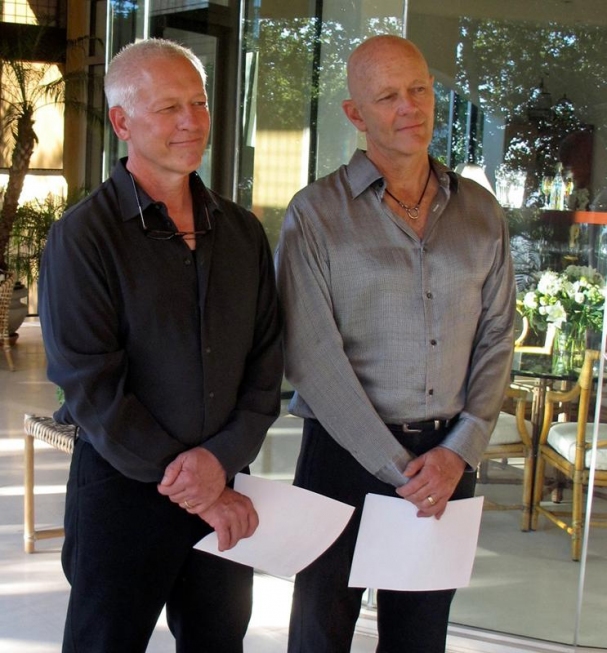
One of the best things about gay marriage being legalized in several states is that we are seeing public acknowledgement of hundreds of gay couples, many of whom have been together for years and most of whom don’t look like movie stars or fashion models, thereby giving the lie to the horrible myth that says “Stay young and beautiful if you want to be loved.”

jim nabors and hubby George Cadwallader  dwight-holden-ted-eudy-pride.widea  gay_marriage_couple_AP110721111737_fullwidth_620x350 YE Top 10 Stories

Like Cappel, I have clients who fret that they’re too fat, too thin, too old, not muscley enough, and/or their dicks are too small, they don’t live up to some standard of gay male beauty, therefore they can’t bring themselves to date or have sex. This is almost always perplexing to me, because evidence to the contrary is sitting right in front of me. But it’s never very helpful for a therapist to say, “That’s a dumb thing to think! Stop that right now!” With someone who’s suffering with self-judgment about his looks, I usually try to find out where he got his ideas about what he’s supposed to look like. He had to be carefully taught some standard of appearance — who or what does he see as the authority in this matter?

That investigation is easier said than done. A lot of these messages get implanted so young that you can’t remember where they came from, except a vague sense of “society told me.” There is a stereotype about gay men that we are fixated on appearances — that’s fine when it comes to fashion and design and flowers and food and interior decoration, but it makes us shallow as people. Well, that judgment overlooks the impact of our personal histories. Unless you grew up in an unusually accepting environment, you probably grew up quite fearful that other people would find out that you’re “different.” To survive, you probably paid close attention to other kids to figure out how you were supposed to look or act in order to pass for some version of normal. This hypervigilance carves all kinds of wounds on our souls, not the least of which is internalized homophobia — a conscious or unconscious aversion to looking “gay” (which usually means effeminate) and overvaluing acting “straight” (which often means hypermasculine).

When men I talk to can actually identify where they got their ideas about what they should look like, nine times out of ten the answer is gay porn. Now, gay porn is an extremely delightful form of contemporary entertainment, and I enjoy it as much as anyone else. It’s also an extremely codified realm whose inhabitants bear little relationship to what average gay men look like. Nevertheless, porn implants the notion that every guy has a huge dick and big muscles, every guy can get it up and fuck on command or get fucked at will and shoot a huge load every time. Somewhere in our brains we know intellectually that it’s an edited medium, that the films and pictures leave out all the messy bits, that the models all take enhancement drugs (often injecting them into their penises) in order to perform like porn stars. Yet somehow we can’t help comparing our bodies to their bodies and finding ourselves lacking.

Cappel’s article references Alan Downs’s book The Velvet Rage, which I too think offers a very astute analysis of gay male emotional development and a roadmap to authenticity. Downs outlines three stages of emotional development for gay men. The first has to do with working through toxic shame around being gay. The second has to do with working through shame about imperfection. Shame and anxiety about imperfection is pretty universal — those traits pretty much go with the human condition — but I agree with Downs’ assertion that gay men often go through a particularly intricate dance of striving to be excellent (The Best Little Boy in the World) in order to compensate for the perceived flaw of being gay. In that stage, any flaw can seem threatening to one’s sense of worthiness, and there’s a huge emphasis on getting validation from others. In this state of vulnerability, if you’re not being actively validated, it feels like you’re being actively invalidated, which is excruciating and infuriating and enraging…but rage is unattractive and socially unacceptable so you have to mask it: thus, the Velvet Rage. The third stage of development, in his view, is authenticity, where you have learned to validate your own existence, regardless of other people’s opinion. Again, easier said than done. But it can be done, with hard work and support.

FOOD FOR THE JOYBODY: the myth of “New Year, New You” and theories of change

Image

Thanks to my friend Ben Seaman, I started exploring the prolific writing of Oliver Burkeman and came upon his column for Newsweek/The Daily Beast on failed New Year’s resolutions, which has some smart things to say. One passage stood out for me:

[A]s the Buddhist-influenced Japanese psychologist Shoma Morita liked to point out, it’s perfectly possible to do what you know needs doing—to propel yourself to the gym, to open the laptop to work, to reach for the kale instead of the doughnuts—without “feeling motivated” to do it. People “think that they should always like what they do and that their lives should be trouble-free,” Morita wrote. “Consequently, their mental energy is wasted by their impossible attempts to avoid feelings of displeasure or boredom.” Morita advised his readers and patients to “give up” on themselves—to “begin taking action now, while being neurotic or imperfect or a procrastinator or unhealthy or lazy or any other label by which you inaccurately describe yourself.”

The column also talks about the alluring fantasy of creating change by “making a fresh start,” throwing everything out and building a new structure from scratch — a task so daunting that it’s rarely successful. I tend to subscribe to the ideas laid out by Arnold Beisser in his essay “The Paradoxical Theory of Change,” one of the pillars of contemporary gestalt therapy. Beisser’s perception is that we don’t change by willing ourselves to do something different but by examining carefully what it is we are actually doing right now, which paradoxically arms us with more information and more options that we often skip when we’re trying to motivate ourselves by envisioning that “fresh start.”

Sex in the cinema: THE SESSIONS

SEX IN THE CINEMA: The Sessions

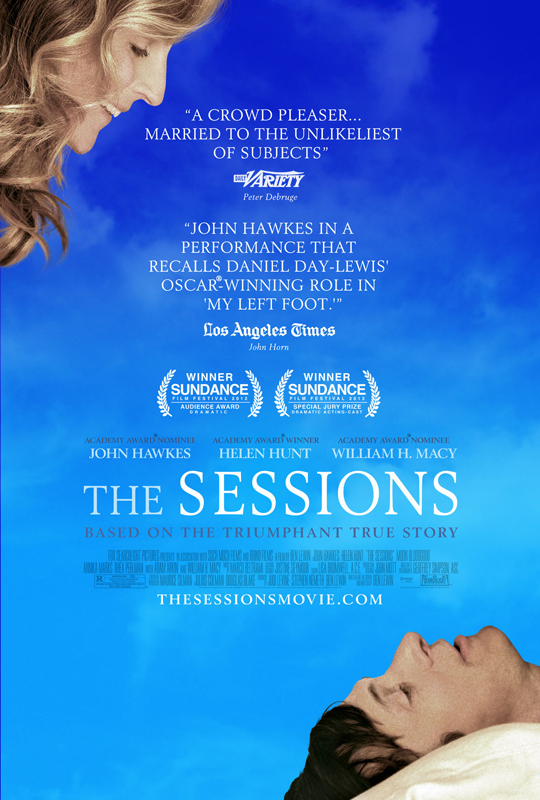
Have you ever wondered what someone who works in the field of sex therapy thinks about The Sessions? I can tell you.

sessionsposterfoxsearchlight

A few weeks ago I watched Ben Lewin’s film, in which Helen Hunt plays Cheryl, a sexual surrogate who is hired by Mark, a severely disabled man (John Hawkes) living with cystic fibrosis. Like many Hollywood movies these days, the film is “based on a true story” about Mark O’Brien, a journalist and poet in Berkeley, California, who was the subject of an Academy Award-winning short documentary feature called Breathing Lessons, which mostly portrayed the life of someone who spends much of his day in an iron lung. The Sessions zeroes right in on the most intimate aspects of O’Brien’s life, his relationships with the staunch female caretakers who bathe him and evince subtle/overt disgust for his body, and his wistful desire to experience sex before he dies. The sexual surrogate that Hunt plays is herself a kind of sacred intimate, a social worker whose job entails getting naked and physically intimate with her clients, with the intention of healing.

My overall response is to be impressed with Hollywood for being willing to make a film on this subject and to treat it with as much honesty and respect as they did. I give Helen Hunt a lot of credit for being willing to be so free with her body and the filmmakers for making a film that many people can identify with whose circumstances are very different from Mark O’Brien’s. The tone is neither sniggery-salacious nor overly solemn. I keep thinking about the moment when she invites him to touch her breasts and says, “If you touch one, you have to touch the other. It’s kind of a rule.”

As a professional, I could take issue with a few things that are “Hollywoodized” and not an accurate depiction of sexual surrogate work. Her first session with him is way too rushed. Most sexual surrogates do NOT walk in the door and get naked nearly as quickly as she does. Especially with someone whose issue is lack of sexual experience, there’s usually a process of progressive desensitization to anxiety-provoking situations. Of course, that would be tedious to document on camera. The film plays up the dramatic moment of her “hurting” him at the beginning, to establish his extreme sensitivity, but it makes her look obtuse, and that seems pretty unrealistic to me. In the scenes where he ejaculates immediately, the movie suggests that the encounter is over when that happens, which is exactly the nightmare that men who struggle with rapid ejaculation fear. In real life, in Mark’s sessions with the surrogate, she didn’t end the session there but continued to work with him to let him regain his erection and experience arousal longer. And at the end, her emotional attachment to him is exaggerated in a way that is sentimental and melodramatic — typical for a Hollywood movie but way overplayed as a depiction of how most sex surrogates deal with completing treatment.

It’s very interesting to go back and read Mark O’Brien’s essay “On Seeing a Sex Surrogate,” which was published in The Sun. You can read it online here. You’ll see that the movie hews to certain facts and embellishes many others. At the time of his sessions with Cheryl, he was 4’7″ and weighed 60 pounds. Such a brave man!

You can also view Breathing Lessons online here (and I encourage you to).

I don’t do sexual surrogacy, but – as I’ve written about elsewhere – there are similarities and differences between sexual surrogates and sacred intimates. For instance, I’ve worked on and off for nine years with a man who has a version of increasingly disabling muscular dystrophy, gets around in a state-of-the-art motorized wheelchair, and has very little ability to move his limbs. Getting him out of the chair and onto the massage table, and then back, is extremely arduous, but it is very meaningful to him to receive the kind of loving touch I offer, which is somewhat different from what he receives from his husband. And it’s meaningful to me to provide a safe place for him to have this experience. I always feel very honored to work with people who have unusual bodies, knowing how emotionally fraught it is for them to show themselves to others. And I think they get about me that I have a lot of reverence for the life and pleasures that are possible in each individual body.