QUOTE OF THE DAY: Sex

SEX

Sex is not always about reproduction or about love or about tenderness. All too easily sex derails from its species errand and becomes entwined with anger or guilt or fear, and thus the vast spectrum of human fantasies arise. This man needs to think of shoes in order to perform, and this woman dreams of spankings, and that man wants to wear and dress so his penis can engorge, and that woman thinks of whips and chains. In the darkness of his soul, this man wants little girls and that man wants little boys, and this woman needs an imaginary crowd to watch her movements and that one finds her satisfaction in piercings of the private parts urine, feces, animal costumes may all play a part in our fantasy lives.

Each sexual story has its origins in early years, in memories and wirings that we can hardly fathom, in our genes or in our nurseries or in our first experiences of our bodies, our own and those of others. We understand some things but just a few. Sexual preferences, some infused with hate or guilt, remain a mysterious continent open to exploration, open to spelunkers brave enough to follow the clues downward into our blackest hearts and our earliest memories. How good it would be to better understand the roles of shame and curiosity and pain and what part they play in our sexual lives. We have just begun to map our own complex minds.

But this list of sexual wishes, odd practices, less-than-dignified desires, compulsions is not confined to one sex or the other. It is a feature of sexuality that affects many human exchanges, and even more private dreams. Perhaps these rise from the efforts we make to control our lusts, or perhaps they rise from strange coincidences, stray moments that became electrified in our memories, or perhaps they are the result of the controls we must exercise as human animals who can restrain impulses but pay the price for that restraint.

Maybe as we think more about our sexual lives we will find better ways to enjoy them, to fuse them with love and release them from hate. Or maybe not. But, either way, the species needs the sexual life of both male and female in order to reach out into time, enduring civilization while dragging its discontents behind it.

–Anne Roiphe, “Order and Desire”

"Obscene" by Mel Bochner

“Obscene” by Mel Bochner

RESOURCES: a happy transgender story

Life can be challenging, disruptive, dangerous, and unhappy for transgender individuals. We’ve heard a lot of rough stories about people who may or may not have made it through the transition facing every kind of difficulty — social, spiritual, financial, medical, hormonal, physical, interpersonal. Here’s one story that is quite happy. In a little over four minutes, Skylar narrates his story as a slideshow of photos of his life. Not every trans person has his privileges and blessings — he seems to have extraordinary acceptance by his family and peers, financial resources sufficient to have $7500 worth of top surgery as a college freshman, good healthcare. Um, he’s white. Nevertheless, his video is worth watching to hear the story from the beginning and understand that the story can have a happy ending.

DID YOU SEE: Richard Kearney on touch in the Sunday NY Times

2007 postcard

Almost every day I have at least one session with a client that confirms two of the basic principles underlying my Body and Soul Work practice: “Touch Heals” and “Healing Through Pleasure.” For people who live with chronic pain, either emotional or physical, the nervous system constructs a four-lane highway between the brain and the cells that signal pain and suffering, so that virtually all other perceptions get left in the dust. But even just an hour of skillful, safe, loving touch can shift someone’s experience entirely, serving as a reminder that alongside pain and suffering, even a chronically ill body is capable of joy, pleasure, and relief.

In a fascinating and thoughtful essay published today in the New York Times’ Sunday Review, philosopher Richard Kearney, who teaches classes about the history of eros at Boston College, discusses the place of touch in our digital culture. He notes that we are much more likely to touch screens these days than each other, even when negotiating sexual connections via social media. Scholar that he is, he looks back to the ancient Greeks for similar dialogue about the rivalry between the sense of touch and the sense of sight:

In perhaps the first great works of human psychology, the “De Anima,” Aristotle pronounced touch the most universal of the senses. Even when we are asleep we are susceptible to changes in temperature and noise. Our bodies are always “on.” And touch is the most intelligent sense, Aristotle explained, because it is the most sensitive. When we touch someone or something we are exposed to what we touch. We are responsive to others because we are constantly in touch with them…

Aristotle was challenging the dominant prejudice of his time, one he himself embraced in earlier works. The Platonic doctrine of the Academy held that sight was the highest sense, because it is the most distant and mediated; hence most theoretical, holding things at bay, mastering meaning from above. Touch, by contrast, was deemed the lowest sense because it is ostensibly immediate and thus subject to intrusions and pressures from the material world. Against this, Aristotle made his radical counterclaim that touch did indeed have a medium, namely “flesh.” And he insisted that flesh was not just some material organ but a complex mediating membrane that accounts for our primary sensings and evaluations.

Consider for yourself what you touch on a daily basis. How much flesh do you make contact with in your life? How do you perceive it in relation to touching other surfaces? Do you appreciate it more, or do you notice any distinction at all?

Check out Kearney’s essay in full here and let me know what you think.

julia jellison

Understanding Social Anxiety

This article was published online by Edge On the Net August 14, 2014.

What’s the difference between fear and anxiety? Fear is a normal emotional response to a clear and present danger. Anxiety is the persistent experience of fear in the absence of threat.

I gleaned this succinct and useful distinction from Richard A. Friedman’s front-page essay in the New York Times Sunday Review called “Why Teenagers Act Crazy.” Friedman, a psychiatrist and professor who directs the psychopharmacology clinic at the Weill Cornell Medical College in New York City, summarizes recent research suggesting that “Largely because of a quirk of brain development, adolescents, on average, experience more anxiety and fear and have a harder time learning how not to be afraid than either children or adults.”

Friedman notes that “the brain circuit for processing fear — the amygdala — is precocious and develops way ahead of the prefrontal cortex, the seat of reasoning and executive control. This means that adolescents have a brain that is wired with an enhanced capacity for fear and anxiety, but is relatively underdeveloped when it comes to calm reasoning.”

illustration by Gary Panter for the New York Times

illustration by Gary Panter for the New York Times

Although we associate adolescence with an impulse toward adventure and novelty seeking in the name of rebellion and individuation, this risk-taking is not necessarily carefree. Apparently, adolescents have difficulty learning how not to be afraid. “While we have limited control over the fear alarm from our amygdala, our prefrontal cortex can effectively exert top-down control, giving us the ability to more accurately assess the risk in our environment. Because the prefrontal cortex is one of the last brain regions to mature, adolescents have far less ability to modulate emotions,” writes Friedman.

“Fear learning lies at the heart of anxiety and anxiety disorders. This primitive form of learning allows us to form associations between events and specific cues and environments that may predict danger. Way back on the savanna, for example, we would have learned that the rustle in the grass or the sudden flight of birds might signal a predator — and taken the cue and run to safety. Without the ability to identify such danger signals, we would have been lunch long ago. But once previously threatening cues or situations become safe, we have to be able to re-evaluate them and suppress our learned fear associations. People with anxiety disorders have trouble doing this.”

Because of their relative difficulty in learning to be unafraid, adolescents may not be good candidates for exposure therapy or the use of stimulants like Adderall. “Stimulants, just like emotionally charged experiences, cause the release of norepinephrine — a close relative of adrenaline — in the brain and facilitate memory formation. That’s the reason we can easily forget where we put our keys but will never forget the details of being assaulted.”

Difficulty telling the difference between real and imaginary dangers isn’t confined to teenagers, though. As I read and thought about Friedman’s article, I immediately thought of two different adult gay male clients describing almost identical experiences of social anxiety. Both these men are smart, educated, attractive guys in their forties who have interesting jobs and are established in their fields (publishing and education). And yet both of them feel intensely uneasy walking into a party with other gay men.

Sandy* has been challenging himself to say yes to social invitations more often, so he forced himself to go to a friend’s party but did so with considerable dread. As soon as he arrived at the party, he “knew” it wasn’t going to be fun for him. Everyone knew everyone, he alone was the outsider. He stayed for an hour and then had to leave. At his job, he’s conscientious, organized, motivated to do well, intelligent, experienced, sympathetic, reasonable, a good collaborator. He feels 75% comfortable at work. Where’s that guy in social setting? He disappears, replaced by insecurities: How do I act, sound, look, behave? What can I say that would interest anyone?

Doug* struggles with similar issues of worthiness. He will happily engage with people who approach him in social settings but can’t bring himself to initiate contact because he can’t imagine that he has anything to offer. At a recent social event, he had the impulse to flee early on, but in contrast to Sandy he was able to leave the room and find a private space to collect his thoughts. He realized that he was acting as if there was something deeply scary going on that he had to get away from. But he had to admit that there was no danger in the next room – it was just a group of people hanging out, getting to know each other, and wanting to have a good time. By summoning his inner resources (that executive function Friedman ascribes to the prefrontal cortex) and accurately assessing the level of risk, he was able to expand his tolerance for braving the social environment longer. It takes practice but it pays off.

[*Names and details are changed to protect confidentiality.]

We could say that both Sandy and Doug were caught in the grip of their inner teenager, highly sensitive to fear of rejection, the danger of social disapproval or scorn, and the belief that they would be unable to survive rejection or humiliation. It’s as if every social encounter were an episode of Project Runway, with a visible or invisible committee judging your every move and fully prepared to send packing anyone who doesn’t make the grade.

looking-in

Brain functioning tells part of the social anxiety story, but not the whole story. I was fascinated the following Sunday to read a letter to the editor in the New York Times responding to Friedman’s article. The author, Robert Epstein, is a senior research psychologist at the American Institute for Behavioral Research and Technology and wrote a book called Teen 2.0.

Epstein said: “Studies have shown that about half of American teenagers meet the criteria for some form of mental illness, including anxiety disorders, but I disagree with Dr. Friedman that this is largely because of the properties of a teenage brain. That is a myth perpetuated by a handful of researchers, some of whom are funded by the pharmaceutical industry, which has successfully created a huge new market for psychoactive drugs by promoting the faulty ‘teenage brain’ idea. In more than 100 cultures around the world, teenage turmoil is absent; such cultures don’t even have a word for ‘adolescence.’ If the teenage brain were responsible for the turmoil of our teenagers, we would see it everywhere. We don’t. The turmoil of our teenagers is due entirely to societal practices that infantilize young people and isolate them from responsible adults, trapping them in the frivolous, media-controlled world of ‘teen culture.’ Anthropological research also demonstrates that when Western schooling and media enter cultures where teenagers are highly functional, they typically take on all the pathological characteristics of American teenagers within a decade. The problem is our society, not the brain.”

I’m a little dubious about Epstein’s insistence that his theory “entirely” explains teenage turmoil, but I was grateful for his acknowledgement that cultural factors play a huge role in how social behaviors evolve. Here are some things I understand about social anxiety in adult gay men.

Almost every gay man spent many years of childhood and adolescence either actively suffering harassment, bullying, and abuse for being perceived as gay/effeminate/different or spending considerable amounts of energy trying very hard not to be noticed in order to escape being harassed, bullied, or abuse. For fear of being excluded, we became experts at excluding ourselves. That conditioning doesn’t go away overnight. It takes a lot of time and growth and community-building and external affirmation to get comfortable showing yourself and being accepted as a sexual being. The ultimate goal is to be able to validate your own existence and not give so much weight to what other people think. That usually requires serious commitment to therapy, spiritual work, or some form of self-study.

illustration by Yann Kebbi for the New York Times

illustration by Yann Kebbi for the New York Times

It’s not uncommon for gay men to put socializing on the back burner during their twenties and thirties and to spend all their energy during that time pursuing their professional or academic ambitions. By the times they’re in their forties and fifties, they may well have established a solid professional identity, a sense of accomplishment, and considerable self-esteem – but still feel underdeveloped in the emotional/sexual/romantic arena. It’s not uncommon for men in that position to find socializing deeply awkward, embarrassing, or threatening because they feel highly self-conscious and often ashamed about their inexperience. It’s easy to look around a club or a party and assume that everybody else has superior social skills and feels perfectly at ease and sure of themselves. It’s easy to forget that as gay men we all grew up watching the rituals of heterosexual courtship happening all around us in school and in movies and TV shows. We probably didn’t get to experience the gay equivalent of adolescent flirtation, holding hands walking down the hall, sipping sodas through two straws, etc., so as adults we had to learn to go through those awkward stages of social contact. Every gay guy knows how clumsy and nerve-wracking that can feel. We know how it feels to be outside looking in. And our peers aren’t nearly as judgmental about that as we might imagine they are. But you only learn that by getting out there and doing it, which takes courage and practice and support.

Then there’s the social media, which has the potential to be a handy tool for meeting people and making connections but just as often it turns out to be a shield to hide behind, to avoid contact. How many times have you been in a bar or a public place where the majority of the people around you are staring at their glowing screens rather than communicating with the people standing next to them? We’ve gotten so accustomed to indirect, mediated forms of communication (email, text, Facebook, Twitter, Instagram, Scruff, Grindr, Manhunt, Recon, Adam4Adam, etc.) that we’ve formed our most intimate relationships with our devices and grown strangely out of practice with direct approach and spontaneous interaction. After all, Candy Crush doesn’t make fun of you. Netflix doesn’t give you attitude. E-mail doesn’t judge.

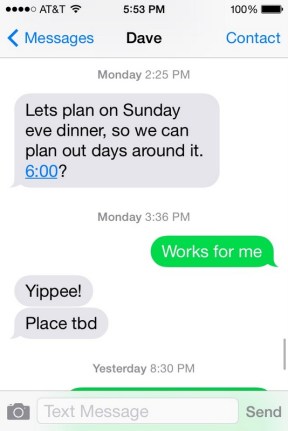
I see this in myself. Just the other day, I had a series of email and text-message exchanges with someone I haven’t seen in a while trying to find time in our busy schedules to get together, go for a walk, have a conversation, and catch up. Then I ran into him at the gym unexpectedly. We could have had some conversation in the locker room. We could have arranged to have coffee right after working out. At the very least we could have seized this opportunity to make a date. Instead, we greeted each other warmly but awkwardly, went about changing clothes and working out, and even sat on opposite sides of the steam room. I realized afterwards that we were acting as if our real relationship existed in our mediated communication and casual face-to-face encounters were some kind of temporary distraction – rather than the other way around.
8-15 davetext

This helped me to understand how easily social anxiety can sneak into our lives. It’s astonishing how much stamina and mindfulness and tolerance for discomfort it can take to stay present in a social interaction without feeling like every momentary lull in the conversation is an agonizing silence or that you’re in the glare of the spotlight and you’re expected to put on a show. I’m thinking about my client Ralph, who prefers communicating in writing because he’s a perfectionist. He’ll labor over each text message or email or G-chat, polishing and deleting and revising until he gets the words just right, which includes making it look like the message was casually tossed off. Then anxiety sets in when he has to meet someone in person that he’s been flirting with on social media. Face to face, in real time, he feels pressure to live up to the witty banter he’s been flinging around on his smartphone. If the conversation doesn’t flow as easily as he thinks it should his self-consciousness can spiral into feeling fraudulent, which doesn’t make for a relaxing meet-and-greet. Paging Cyrano de Bergerac!

The split between the amygdala and the prefrontal cortex that Friedman talked about in his New York Times article doesn’t automatically go away when you turn 21. It comes and goes all our lives, this challenge of learning not to be afraid, of summoning our executive control to see whether there’s real danger nearby or unwarranted fear and then to calm the skittish teenager inside who doesn’t know how to tell the difference.

That’s obviously easier said than done for a lot of people. It takes practice. That’s where taking a meditation class or joining a meditation group can be very helpful – the process of slowing down, watching your mind wander off into the woods, and gently bringing it back instills good practice for expanding your tolerance for situations that cause anxiety. With practice, it gets easier and easier to stop yourself when you’re going into a frenzy and consider: what am I afraid of? Am I really in danger, or am I really not? Most of the time when we fear that we’re being judged negatively by other people, it’s really our own harsh self-judgments that are causing our distress. Meditation can also help you learn and develop an attitude of kindness and compassion toward yourself.

There are other ways to work through social anxiety. Toastmasters is a popular approach, or any fellowship group that encourages people to get together and practice speaking openly in a social setting. Sometimes it takes medication and/or psychotherapy to dislodge old habits of being afraid. And sometimes maturity bestows its own blessing – one of the great things about aging is that at a certain point you stop giving a shit what other people think. But the good news is that your organism is built to understand the difference between fear and anxiety.


QUOTE OF THE DAY: Tea

TEA

“At the Tea Garden”

My friend and I mull over the teas
displayed in square jars
with beveled glass labeled by type.
Each name seems part of a haiku:
“After the Snow Sprouting.” “Moon Palace.”
“Mist Over the Gorges.”
I’m drawn to green teas
with unoxidized leaves that don’t wither,
hold their grassy fragrance
like willow under snow in winter.

The proprietor offers real china for the Chinese tea.
Animal bones, fine ground, give whiteness,
translucency and strength
to the porcelain that appears delicate,
resists chipping.
The rim of the cup is warm and thin.

My friend’s lips are plush: her lovely
mouth opens to give advice I ask for.
We talk about memory of threshold events,
like a first kiss or a poem published.
She can’t remember…

I tell her about my brother-in-law’s
chemotherapy—his third bout of cancer.
He wants his family to put a pinch
of his ashes in things he liked:
his banjo, the top drawer of his desk, the garden.

I wouldn’t mind becoming part
of a set of bone china that serves tea
in a cozy teahouse smelling of incense,
cinnamon, musk, and carved teak.
I’d like to be brought to a small table,
sit between friends’ quiet words,
held in hands so close that breath
on the surface of warm drink
makes mist rise over their faces.

— Margaret Hasse

TeaGardensBG

RESOURCES: on depression

In the wake of Robin Williams’ shocking, sad suicide, I suspect that a lot of people are thinking and talking about depression today. A client whose husband has been severely depressed because of serious medical issues has struggled tremendously with how to understand and respond to the changes in her beloved longtime partner. He did her a huge favor by sending her the link to this article, and I’m passing it along for the benefit of anyone who would like to understand “What It’s Like Inside a Depressed Person’s Head.”

The author, Cynthia Lubow, details the dark and distorted thinking that descends upon someone in a major depression, where it is impossible to anticipate a positive future. “Suddenly, no one seems loving or lovable. Everything is irritating. Work is boring and unbearable. Any activity takes many times more effort, as if every movement requires displacing quicksand to make it. What was challenging feels overwhelming; what was sad feels unbearable; what felt joyful feels pleasureless—or, at best, a fleeting drop of pleasure in an ocean of pain.”

For family members and loved ones, it’s important to realize that “When people try to get the person to look on the bright side, be grateful, change his or her thoughts, or meditate, or they minimize or try to disprove the person’s reality, they are very unlikely to succeed. Instead, they and the depressed person are likely to feel frustrated and alienated from one another.”

She rightly points out that cognitive therapy is unlike to be helpful during a major depression, because the depressed person’s thinking apparatus is impaired and not available for healing or alteration. In those times, medication usually proves to be the most effective treatment, along with nutrition, acupuncture, and other body-based treatments.

Check out the article here and let me know what you think.

sad_sad_clown_by_aly_kairi-d3k7psv


DID YOU SEE: Katy Butler interview on death and dying in The Sun

Life in a body goes right up to and includes everything around the experience of dying. I agree with Katy Butler, author of Knocking on Heaven’s Door, that we don’t have enough conversations about our hopes, fears, desires, and wishes related to our own deaths. I just caught up with a long and engrossing interview with Butler by Sam Mowe in the April 2014 issue of The Sun, the exemplary literary magazine published monthly in Chapel Hill, NC. I paid particular attention to a passage where she talks about what happens if you’re unprepared: “You may find yourself calling 911 in a panic, which means a trip to the ER and often the ICU.”  It brought me into vivid contact with the memory of one of the most important days of my life, when I was caring for my friend Bob in the last stages of AIDS-related lymphoma. I had never been present for someone else’s death, and when it was clear the time was coming, as his primary caregiver I couldn’t think of what else to do but exactly that, call 911. In the emergency room at St. Luke’s Roosevelt, a doctor said to me bluntly, “Why did you bring him here? There’s nothing we can do. You should have kept him at home.” He was right. I wished later that I had, but at the time I was completely unprepared, practically and psychologically, to manage a home death.

Have you thought about these questions? I really encourage you to. In this passage from the interview, Butler gives some very helpful guidelines for how those conversations might go.

katy-butler-photo

What are some of the barriers in our culture to talking openly about death?

Number one is that Americans love technology and have too much faith in it. We live with the illusion that our technologies will always save us.

Number two is that we’re unfamiliar with death. There was a time when it would have been rare for a person in middle age not to have lost a child, a parent, or a sibling. People are unpracticed at seeing death and coping with death, because we’ve pushed it to extreme old age and hidden it away in the hospital.

Number three is that we’re just embarrassed to talk about death, even more so than we are to talk about sex. An eighty-five-year-old might say to her kids, “I probably don’t have more than another five years,” and the kids will say, “Oh, Mom, don’t be morbid. You’ve got lots of time. You’re healthy.” We act as though it’s unloving to talk about the reality of death, as if it means we are trying to throw our parents under the bus. We think that we’re being loving when we’re optimistic, but optimism is one of our problems. Americans have a misguided sense of how much, or what sort of, hope is appropriate.

What do you mean?

I mean it’s honest to hope that you might heal your relationships before you die. It’s dishonest to say to a dying person, “We have very good results from this treatment,” when it might mean a 17 percent chance of surviving an extra three months.

In this culture everybody’s trying to put the best spin on reality all the time. Americans feel like failures if they can’t control and manage everything, but death is uncontrollable and unmanageable.

How can we have end-of-life discussions? What should they consist of?

We need to start the discussion way upstream. You have one discussion when you’re totally healthy and the only thing you’re worried about is an accident that leaves you with major brain damage. When you’re in your seventies and eighties and you have multiple chronic illnesses, you have a different conversation with your healthcare provider. At that point you might welcome a relatively peaceful and sudden death and obtain a Do Not Resuscitate bracelet, since your odds of surviving CPR intact are slim anyway. You might want to refuse dialysis or open-heart surgery.

When you’re within a year of dying or you have terminal dementia and have to be locked up, the conversation changes again. Maybe you want comfort care only. Maybe you want to refuse antibiotics or a feeding tube – anything that causes you stress and prolongs your life. You may have come to the point where you see pneumonia as the “old person’s friend,” as doctors used to call it. So long as your pain is addressed, you’re ready to die.

In my family we were blunt. I could ask my dad in the months following his stroke, “Is your life still worth living?” and he didn’t take offense. I could say to my mother, “I think we’re grasping at straws.” Not all families are like this. One good way to start is to ask, “Have you thought about who you want to make medical decisions for you when you can’t make your own?” and “What do you want that person to know?” I can think of no better legacy to leave the next generation than to give them clarity on this. “Just take me out to the field and shoot me” is not an end-of-life plan. Nor is “You’ll know what to do when the time comes,” because loved ones often don’t. Older people should have clear directives in place so they don’t leave their children conflicted and heartbroken and guilty about, say, discontinuing life support.

Likewise, I can think of no greater gift to give a dying parent or spouse than to put him or her on the pathway to a peaceful and timely death free of unnecessary suffering, even if this means opposing the advice of doctors or having intense discussions with other family members. For many people the best death is still a home death. And getting on the pathway to a home death means facing the fact that death is coming long before it knocks on the door. It means bringing in palliative care and then hospice. Otherwise you may find yourself calling 911 in a panic, which means a trip to the ER and often the ICU.

I don’t think we should see these discussions as strictly medical or legal. They’re not just pieces of paper. They are discussions about your deepest values. Whom do I love and trust? What makes my life worth living? Do I have a right to say, “Enough”? How do I want to die? What do I owe my descendants? When is it OK to let go?


QUOTE OF THE DAY: Daring Greatly

DARING GREATLY

It is not the critic who counts, not the man who points out how the strong man stumbles, or where the doer of deeds could have done them better. The credit belongs to the man who is actually in the arena, whose face is marred by dust and sweat and blood; who strives valiantly; who errs, who comes short again and again, because there is no effort without error and shortcoming; but who does actually strive to do the deeds; who knows great enthusiasms, the great devotions; who spends himself in a worthy cause; who at the best knows in the end the triumph of high achievement, and who at the worst, if he fails at least fails while daring greatly.

— Theodore Roosevelt

teddy roosevelt

Quote of the day: SAFETY

SAFETY

The norms for eye contact vary all over the world. Eye contact isn’t always a positive thing. It can be threatening, too. When you’re feeling safe, eye contact can seem friendly, but without a sense of safety, it can be perceived as aggressive. There’s good evidence that people who are depressed, anxious, or lonely experience fewer feelings of safety around others, and that starts a downward spiral in which they cut themselves off because any interaction, to them, seems threatening. They may want to connect, but their actions don’t support that desire, which reinforces their loneliness. Mindfulness meditation – in which the meditator is simply present in the moment without judgment – may help you begin to see a safe situation for what it is, instead of projecting your negativity onto it. After you’ve deal with some of that initial negativity and are feeling safer, lovingkindness meditation might help you experience more warmheartedness.

— Barbara Frederickson interviewed in The Sun

fredrickson_barbara_11web2-2

EVENTS: erotic massage class at MMX

THE ART OF EROTIC MASSAGE
A class for men led by Don Shewey at MMX (Male Massage Exchange) in New York City
Four evenings: June 12th, 19th, 26th, and July 10th
7:30 -10 pm.

In this series, you will learn the art, the technique, and the energy to give and receive a REAL Erotic Massage.

For some people, erotic massage is a shady step-brother to legitimate massage – some version of a half-assed backrub and a handjob. But there is a higher octave of erotic massage that can be a transformational experience. What makes an erotic massage extraordinary isn’t just the sensual bits but the acknowledgement of the whole person. It’s an opportunity to connect the dots between the physical and the emotional, the erotic and the spiritual.

In this four-part training with an erotic massage master, you will learn to give a full-body erotic massage that is skillful, pleasurable, energizing, and soul-nourishing.

June 12th:  WEEK 1 Simple Touch

Simple, nurturing touch is so important. Massage that includes genital touch plus breath plus presence feels like acceptance. Especially for gay men, it’s very meaningful to get permission and encouragement to receive pleasure, to feel your whole body, to speak desires, to bring consciousness to sex and touch, to live your spirituality without blocking your sexuality and vice versa, to be seen naked, to see another man naked. All these are opportunities to heal shame, isolation, erotic malnutrition, and touch deprivation.

This class will focus on some basic massage moves designed to put someone at ease, help him arrive in his body, and let go of stress and tension. We will work on the back, neck, shoulders, legs, and feet, not so much focused on the medical or sports massage fix-it model but more in the direction of pleasure, relaxation, and connection.

June 19th: WEEK 2 Tantric Massage

The essence of tantra has to do with understanding erotic interaction as a metaphor for union with the divine.

MMX massage 1
The intention of tantric massage is to open the heart, to cultivate your own orgasmic capacity, and to experience sexuality as energy. This class will demonstrate and teach how to skillfully integrate touch, breath, and erotic energy into a full-body massage. You will get to observe and then practice giving and receiving a series of cock-massage strokes intended to raise and circulate erotic energy around the body so it’s a full-body experience, culminating in an exercise in conscious breathing called The Big Draw. You may be surprised to discover how pleasurable and nourishing it is to relish arousal without the goal of ejaculation.

June 26th:  WEEK 3 Butt Pleasure

Here’s one area of the body that is a major pleasure center for many guys but that traditional massage virtually never addresses. This class will provide a safe playground to explore the rich territory of pelvic massage, focusing on the buttocks, the anus, and the perineum for pleasure and relaxation. There will be a demonstration of the variety of ways to touch, knead, manipulate, and caress every part of a man’s rear end for pleasure and relaxation. The instruction will include “rosebud” massage (external) as well as sphincter and prostate stimulation (internal). You will have the opportunity to give and receive butt massage, at whatever pace and level you and your partner feel comfortable with (which may or may not include internal massage). You will get to practice not just the touch aspects but also how to verbally communicate with your partner about what feels good, what doesn’t, and what edges you’re willing to explore. We will use disposable gloves and observe hygiene protocols so the exploration will be completely safe for all participants. Discover the sometimes subtle delights available in the nether regions when the agenda is run by pleasure rather than the requirement of penetration.

MMX massage 2

July 10th:  WEEK 4 Putting It All Together

What really makes an erotic massage satisfying is the full-body experience. In this session we will put together the pieces we learned and practiced in the earlier sessions, with some instruction and guidance in transitions. You will get the opportunity to give and receive a luscious full-body massage that includes erotic touch. Part of the practice involves tuning into the specific partner you’re with and tailoring your touch and your attention to his individual body and his pleasure.

The class is geared toward healthy holistic healers, trainers, dancers, and athletes – people who work with body and energy and are height/weight proportionate.

RATES:
$199
Discounts for under 30, premium members, and bodyworkers.
Questions or More Info:  mmxnyc@gmail.com